






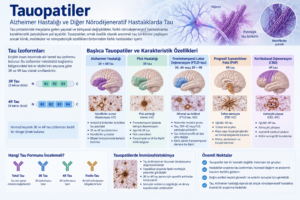
Tau has important functions, particularly in the central nervous system. microtubule-associated protein (MAP) It is defined as such. One of its best-known functions is contributing to the regulation of microtubule organization and dynamics in neuronal cells.
Microtubules are not only structural components of the cytoskeleton. They play a crucial role in establishing pathways necessary for intracellular transport, particularly in neurons with long axons. Therefore, the interaction of Tau with microtubules is an important component of normal neuronal function.
However, the biological behavior of tau protein is not stable. Various processes, primarily phosphorylation, can occur. post-translational modifications, This can alter tau's interaction with microtubules, its intracellular distribution, and its association with other molecules.
Disruption of these regulatory mechanisms on tau is associated with the pathological processes observed in Alzheimer's disease and other tauopathies.
What is the normal cellular function of tau protein?
Microtubules are dynamic cytoskeletal structures composed of tubulin proteins. They play a role in maintaining cell shape and transporting organelles, vesicles, and various cellular components.
This system is particularly important in neurons.
A significant distance can exist between the cell body and the axon terminal of a neuron. A functional microtubule network is necessary for the controlled transport of proteins, vesicles, mitochondria, and other cellular components across this distance.
Tau interacts with microtubules, contributing to the regulation of the organization and dynamics of these structures.
However, the link between tau and microtubule is not permanent. This interaction needs to be dynamically regulated so that the cell can respond to changing needs.
One of the important mechanisms of this regulation phosphorylation.
What is Tau Phosphorylation?
Phosphorylation is a reversible post-translational modification that occurs through the addition of phosphate groups to specific amino acid residues found in proteins.
Protein kinases regulate the addition of phosphate groups, while protein phosphatases regulate their removal.
Tau protein contains numerous potential phosphorylation sites and can be phosphorylated under physiological conditions. Therefore... Tau phosphorylation itself is not a pathological event.
What matters is knowing in which regions, at what level, and under what cellular conditions phosphorylation occurs.
When the phosphorylation status of tau changes, its binding properties to microtubules can also change. While this mechanism normally contributes to the regulation of microtubule dynamics, disruption of phosphorylation balance can lead to altered tau function.
Why is hyperphosphorylated tau important?
One of the most studied molecular alterations in Alzheimer's disease and various tauopathies is the abnormal phosphorylation of tau.
Increased phosphorylation in certain regions can reduce tau's binding properties to microtubules. Tau that detaches from microtubules may accumulate within the cell and easily form different molecular structures.
As the pathological process progresses, tau molecules can aggregate to form oligomeric structures and, in more advanced stages, fibrils.
Observed in Alzheimer's disease neurofibrillary tangles (NFTs) One of its key components is an abnormally modified tau protein.
However, current research indicates that tau pathology is not limited solely to neurofibrillary tangles formed in the final stages. Soluble forms of tau, its oligomers, different conformations, and post-translational modifications are also being investigated for their contribution to understanding neurodegenerative processes.
Is Total Tau Measurement Always Sufficient?
A key distinction in tau research. total tau and modified tau forms It is among them.
An antibody that recognizes total tau can help assess the overall presence or quantity of the protein. However, determining only the total tau amount is not always sufficient to determine the molecular state of the protein.
Two biological samples containing the same amount of tau may exhibit different phosphorylation profiles, conformations, isoform distributions, or aggregation statuses.
Therefore, depending on the research question:
total tau,
phosphorylated tau,
certain tau isoforms or
other modified forms of tau
They can be evaluated separately.
The key point here is that the antibody used must be compatible with the research question.
Do all phosphorylation sites mean the same thing?
No.
Numerous phosphorylation sites have been identified on tau, and the biological effects of these sites are not identical.
Regions frequently studied in Tau research include, for example:
Thr181, Thr217, Thr231, Ser396 and Ser404
It contains amino acid residues such as these.
While some phosphorylation sites are associated with tau's interaction with microtubules or its aggregation properties, others are being extensively studied as biomarkers in Alzheimer's disease research.
However, explaining tau biology through a single phosphorylation site is often insufficient.
Post-translational changes on tau a combinatorial structure This can be demonstrated. In other words, the behavior of a protein may be affected by the overall molecular state created by multiple changes on the same molecule, rather than by a single modification.
Therefore, the biological significance of a particular phosphorylation site should be evaluated taking into account the research model and objective.
Is Tau regulated only by Phosphorylation?
In tau research, phosphorylation is one of the most studied post-translational modifications, but it is not the only one.
Tau protein can also undergo acetylation, ubiquitination, methylation, glycosylation, and other post-translational modifications.
These modifications can affect tau's stability, intracellular distribution, protein-protein interactions, and aggregation tendencies.
Therefore, today tau biology is considered a more complex molecular system than simply a linear mechanism of "hyperphosphorylation → aggregation".
Why are phospho-specific tau antibodies used?
Antibody-based methods can be used in tau research to examine the quantity, cellular localization, and specific molecular forms of the protein.
One pan-tau or total tau antibody, It can recognize an epitope that is common to different forms of tau.
Against this a phospho-specific tau antibody, It is developed against the phosphorylated form of a specific amino acid.
For example, an antibody that recognizes p-Tau Thr231 and an antibody that recognizes total tau will not answer the same biological question.
This distinction is particularly important:
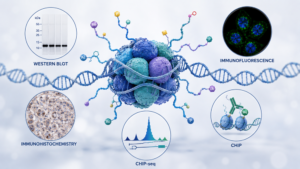
Western Blot,
immunofluorescence,
immunohistochemistry,
immunoprecipitation And
In immunoassay methods such as ELISA
It is important.
The researcher must first determine whether they are seeking an answer to the question, "Is Tau present?" or "Is there a specific phosphorylated form of Tau?".
Why is specificity important in phospho-specific antibodies?
Specificity is particularly important in antibodies targeting post-translational modifications.
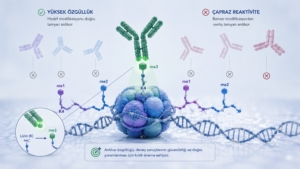
A phospho-specific antibody not only needs to recognize the protein in question; it must also be able to distinguish the targeted phosphorylation state.
For example, undesirable cross-reactivity of an antibody developed against a specific tau phosphorylation site to the non-phosphorylated form of the same site or to differently modified epitopes in nearby regions can affect the interpretation of experimental results.
Therefore, when selecting antibodies for tau research, it is important to consider the target epitope, phosphorylation site, application method, sample type, and available validation data together.
This approach we discussed earlier Specificity in histone modification antibodies It is also based on a similar scientific principle in its subject matter: it investigates not only the existence of the molecule being studied, the correct molecular form It is necessary to recognize them.
HUABIO Antibodies in Tau Research
The fact that tau contains numerous isoforms and post-translational modifications makes antibody selection appropriate to the research question crucial.
Included in the SpesBio portfolio HUABIO tau antibodies, These include antibody options targeting different phosphorylation sites in addition to total tau.
Antibodies targeting different tau targets are offered by the manufacturer for various research applications such as Western Blot, immunofluorescence, immunohistochemistry, and immunoprecipitation. HUABIO states that its current portfolio includes phospho-tau antibodies targeting 11 different phosphorylation sites.
When selecting a product, it's not just the target protein that matters; the recognized epitope, the phosphorylation site, the sample type, and the experimental method to be used It is important to evaluate them together.
Conclusion
Tau protein is an important protein involved in microtubule organization and intracellular processes in neuronal cells. Tau's function is regulated by numerous post-translational mechanisms, primarily phosphorylation.
While physiological phosphorylation is part of the normal regulation of tau function, changes in tau phosphorylation balance and abnormal tau accumulation are closely associated with the molecular pathology seen in Alzheimer's disease and other tauopathies.
Therefore, in tau research, simply assessing the total amount of protein may not be sufficient for every research question. Which isoform of tau, which post-translational modification, or which phosphorylation site is examined can significantly alter the biological significance of the experimental results.
The increasingly detailed understanding of tau biology, The importance of research approaches progressing from total protein levels to molecular form-specific analyses. It increases.
To inform
This content has been prepared for general informational purposes, drawing upon scientific literature and reliable technical sources in the fields of tau protein, phosphorylation, and neurodegeneration. The selection of antibodies and methods to be used in research applications should be evaluated according to the experimental model and the validated operating conditions of the laboratory.