






What is γH2AX? The Role of Histone H2AX in DNA Damage Research
Entrance
DNA can be subjected to various types of damage continuously throughout the life of a cell. Cells have complex DNA damage response systems to recognize this damage, generate signals, and activate repair mechanisms.
Within this system, histone variants H2AX It holds an important place.
The structure formed as a result of phosphorylation of H2AX at a specific amino acid following DNA damage. γH2AX It is called.
What is H2AX?
H2AX is a variant of the H2A histone family.
γH2AX is formed as a result of phosphorylation of the amino acid Ser139 located in the C-terminal region of H2AX.
In cases of severe DNA damage, such as DNA double-strand breaks, this phosphorylation can occur rapidly.
The resulting γH2AX domains contribute to the assembly of various proteins involved in the DNA damage response at the damage site.
Why is γH2AX being investigated?
One of the key characteristics of γH2AX is its ability to be detected in cells following DNA damage.
Specifically, imaging of γH2AX foci (foci) via immunofluorescence is one of the commonly used approaches in investigating DNA damage response.
Researchers have used γH2AX, for example:
- In DNA damage studies
- In radiation research
- In genotoxicity studies
- In the investigation of DNA repair mechanisms
- In cellular stress studies
can examine.
How is γH2AX detected?
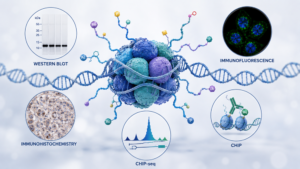
γH2AX can be investigated using various experimental methods.
Immunofluorescence
γH2AX foci in the cell nucleus can be visualized with IF.
This approach allows for evaluation at the cellular level.
Western Blot
Western blot can be used to assess changes in γH2AX levels in a sample.
Immunohistochemistry
The γH2AX signal can be investigated in tissue samples using the IHC approach.
This method can be particularly useful when tissue morphology needs to be evaluated in conjunction with other factors.
Is γH2AX a definitive indicator of DNA double-strand breaks?
There is an important distinction here.
γH2AX is strongly associated with DNA double-strand breaks and is therefore used as an important marker in DNA damage research.
However, γH2AX only a definitive and unique indicator of DNA double-strand breaks It is not correct to consider it as such.
The literature has shown that γH2AX formation can also occur under different DNA damage and replication stress conditions.
Therefore, it is important to evaluate the experimental results in conjunction with other biological indicators and appropriate controls.
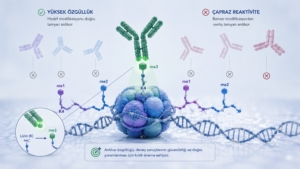
Why is antibody selection important?
The targeted construct in γH2AX research is highly specific:
H2AX phosphorylated at Ser139
Therefore, the antibody used must correctly recognize the phosphorylated Ser139 region.
The method used can also affect antibody performance.
Therefore, researchers are choosing antibodies based on:
- Target area
- APPLICATION
- Validation
- Positive/negative controls
- Example type
Factors such as these should be considered.
Conclusion
γH2AX is a key example of histone biology in the investigation of DNA damage response.
H2AX phosphorylation at Ser139 is part of the molecular response following DNA damage and can be investigated using various research methods.
However, γH2AX results should not be interpreted in isolation; the method used, experimental conditions, and other indicators of DNA damage must be considered.