








Entrance
The use of antibodies in histone research can provide researchers with invaluable information. However, the reliability of this information largely depends on how accurately the antibody used identifies its target.
Therefore, in histone antibodies specificity This topic is an important part of experimental design.
This issue becomes even more important, especially in cases of histone modifications that are very similar to each other.
Why can similar goals be a problem?
The amino acid sequences located in the short tail regions of histones can be very close to each other.
For example, H3K4me1, H3K4me2, and H3K4me3 represent different methylation states at the same amino acid position.
If an antibody cannot adequately distinguish between these three targets, the experimental result may be misinterpreted.
A comprehensive study published in 2018 systematically examined 52 commercial H3K4 methylation antibodies and showed that many antibodies distinguished different methylation states with less specificity than expected.
This is particularly important in applications like ChIP, where results are translated into genomic interpretations.
Neighboring modifications are also important.
Histone tails can contain multiple modifications.
Methylation or acetylation of an amino acid can affect the recognition of a neighboring modification by antibodies.
Therefore, testing whether an antibody binds only to its target peptide may not be sufficient.
In more comprehensive specificity assessments:
- Untargeted peptides
- Similar modifications
- Different methylation states
- Adjacent amino acid changes
- Peptides containing multiple modifications
Such controls can be used.
Antibody validation
Different validation approaches can be used in the evaluation of histone antibodies.
Some of them are:
- Peptide-based tests
- Peptide array analyses
- Recombinant proteins
- genetically modified cells
- Positive and negative controls
- Comparison on different experimental platforms
It is in this form.
It is particularly important to properly validate the antibody for the application in which it will be used, rather than relying on the results of a single experiment.
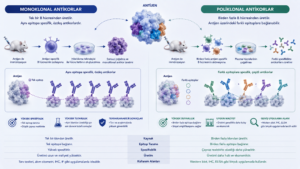
Are monoclonal antibodies better?
The production of monoclonal antibodies from a single clone allows for the obtainment of a more defined antibody population directed towards a specific target.
However, being "monoclonal" alone does not mean that an antibody is better or more specific in every application.
The actual performance of the antibody should be evaluated experimentally.
Location of recombinant antibodies
Recombinant antibody technologies are also used in histone research.
One of the key advantages of recombinant antibodies is that they can reduce variability between lots by allowing the reproduction of a defined antibody sequence.
A study published in 2013 demonstrated that recombinant antibodies against histone PTMs may offer advantages in terms of high specificity and affinity, as well as inter-lot variability.
This is a particularly noteworthy feature for long-term and reproducible research.
How to choose the right antibody?
When evaluating a histone antibody, the following questions may be asked:
- What exactly is the goal?
For example, H3, H3K27me3, or H3.3?
- Which procedure will be used?
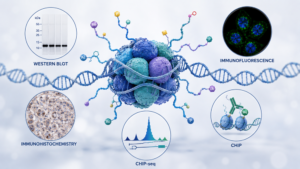
Western Blot, ChIP, IF, IHC, or another method?
- Has the antibody been verified for this application?
- Has cross-reactivity been evaluated with similar targets?
- Are positive and negative controls available?
These questions are fundamental considerations not only in the selection of histone antibodies, but also in the selection of many investigative antibodies.
Conclusion
The fact that histone modifications are distinguished from each other by minor structural differences makes antibody specificity particularly important.
Therefore, a good histone antibody selection should not be based solely on the target name or catalog description.
The objective, implementation, validation, and control results should be evaluated together.