






How are Histone Antibodies Used? Western Blot, ChIP, IF, and Other Research Applications.
Entrance
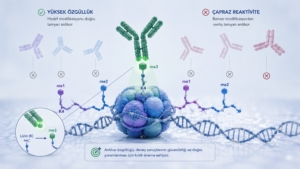
Investigating histones and histone modifications may require the use of antibodies that can recognize the targeted histone protein or a specific modification.
Therefore, histone antibodies are among the important research tools in epigenetics and chromatin studies.
However, the purpose of using a histone antibody is not simply to answer the question "are there histones present?".
The antibody's target may be a specific histone type, histone variant, or a particular post-translational modification.
Western Blot
Western blot is a commonly used method for evaluating the relative levels of proteins in a sample.
In histone research:
- H3
- H4
- H2A
- H2B
- H3K4me3
- H3K27me3
- H3K9me3
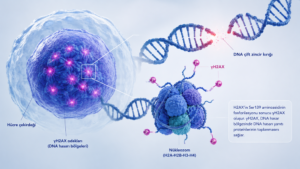
- γH2AX
Such objectives can be explored.
In Western blot analysis, sample preparation, protein quantity, and appropriate controls are all important factors in interpreting the results, as well as the target specificity of the antibody used.
Immunofluorescence
Immunofluorescence (IF) can be used to visualize the location of a target protein or modification within a cell.
For example, in γH2AX studies, it is possible to evaluate signals associated with DNA damage as foci in the cell nucleus.
One of the key advantages of IF is that it can answer not only the question of "how much?" but also "where?".
Immunohistochemistry
Immunohistochemistry (IHC) allows for the examination of histones and histone modifications in tissue samples.
This approach is particularly useful in research where the preservation of histological structure and the evaluation of molecular signals together are desired.
However, IHC performance can be affected by many factors, including tissue fixation, antigen accessibility, antibody characteristics, and staining protocol.
Chromatin Immunoprecipitation — ChIP
ChIP is one of the key methods used to investigate the relationships between histones and DNA.
By using antibodies that recognize a specific histone modification, chromatin fragments containing that modification can be enriched.
The obtained DNA can then be analyzed to investigate its relationship with specific genomic regions.
Therefore, ChIP detects not only the presence of histone modification, but also, where it is located on the genome It can be used for research purposes.
ChIP-seq
ChIP-seq combines the ChIP approach with high-throughput DNA sequencing.
This method allows for the investigation of the genome-wide distribution of a specific histone modification.
However, ChIP-seq results can be directly affected by the specificity of the antibody used. Therefore, the quality of the experimental antibody is as important as the bioinformatics analysis.
ELISA and other methods
Histone modifications can also be evaluated using ELISA-based methods.
In addition, peptide sequences, mass spectrometry, and various biochemical approaches are also used in histone research.
Mass spectrometry offers significant advantages, particularly in characterizing multiple histone modifications simultaneously in the same sample.
Is the same antibody suitable for every application?
No.
Just because an antibody performs well on Western Blot doesn't automatically mean it will perform the same on ChIP, IHC, or IF.
This is due to the fundamental differences between the applications.
While proteins may be denatured in Western Blot, in ChIP the antibody interacts with natural or partially conserved structures within the chromatin.
In both IHC and IF, sample preparation and fixation can affect antigen availability.
Therefore, antibody selection considers not only the target, but also..., the application to be used should be examined.
Conclusion
Histone antibodies can be used for a wide variety of purposes in chromatin and epigenetic research.
Western Blot can be used to investigate protein levels, IF to examine cellular distribution, IHC to investigate localization within tissue, and ChIP to investigate histone-DNA interactions.
Each of these methods answers a different research question.
Therefore, one of the most important questions when choosing the right histone antibody is:
“"In which application and for which research question will this antibody be used?"” should be.