







What are Histone Modifications? Methylation, Acetylation, and Other Epigenetic Markers
Entrance
Histones are not only structural proteins that wrap around DNA. Chemical changes occurring in specific regions of histones can affect the properties of chromatin and the proteins that interact with chromatin.
These changes are in general histone post-translational modifications (PTMs) It is called.
Histone modifications are a key topic in epigenetic research. However, it is not accurate to simply view these modifications as "gene-turning" or "gene-turning" signals. Their effects can vary depending on the type of modification, its amino acid position, neighboring modifications, and cellular context.
The most frequently studied histone modifications
Numerous different modifications have been identified in histones. Among these, the following groups are particularly frequently encountered in research:
- Methylation
- Acetylation
- Phosphorylation
- Ubiquitination
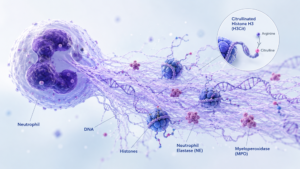
- Citrulination
- SUMOylation
- ADP-ribosylation
- Various metabolic modifications that have been characterized more recently.
Each of these modifications has different biochemical properties.
Histone methylation
Methylation is one of the modifications that is being extensively studied, particularly on histone H3.
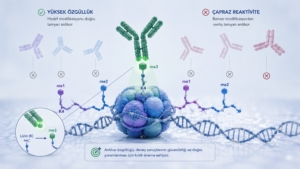
The methylation of a lysine once, twice, or three times, respectively:
me1 → me2 → me3
It is shown as follows.
For example, H3K4me3, H3K27me3, and H3K9me3 represent different histone methylation states.
The important point is this: Histone methylation does not always produce the same biological result.
Although specific methylations have been shown to be associated with different chromatin states, the outcome depends on the location of the modification and the cellular context.
Histone acetylation
Acetylation is also one of the most studied topics in histone biology.
For example H3K27ac, This refers to the acetylation of lysine at position 27 of histone H3.
Histone acetylation plays a role in many processes related to chromatin rearrangement and transcriptional activity.
The balance between acetylation and deacetylation is regulated by enzymes such as histone acetyltransferases and histone deacetylases.
Phosphorylation
Histone phosphorylation is of particular interest in the context of DNA damage and chromatin response.
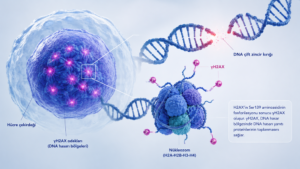
One of the best-known examples of this is the phosphorylation of H2AX at the Ser139 position.
This modification γH2AX It is called DNA damage response and is widely studied in research on DNA damage response.
The topic of γH2AX will be discussed further in later parts of this series.
Ubiquitination and other modifications
Ubiquitination is also an important type of modification in histones.
In addition, research shows that histones undergo citrullination, crotonylation, lactylation, malonylation, and many other modifications.
The scope of histone PTM research is expanding over time.
High-sensitivity methods, such as mass spectrometry, allow for the simultaneous examination of numerous histone modifications in the same sample.
Modifications should not be evaluated in isolation.
One of the key features of histone biology is that modifications should not be considered in isolation from one another.
Multiple modifications can be found in the same histone tail. One modification may affect the recognition of another modification or the binding of related proteins.
Therefore, today histone biology is evaluated not only by examining individual markers, but also through the more complex molecular environment created by modifications.
Why is it important in research?
Studying histone modifications can help researchers understand changes in chromatin state.
For example:
- Regulation of gene expression
- Cell differentiation
- DNA replication
- DNA damage and repair
- Chromatin organization
- Developmental processes
- Cancer biology
Histone modifications are studied in many research areas, such as those mentioned above.
Conclusion
Histone modifications are a key component of chromatin biology.
Methylation, acetylation, phosphorylation, and other modifications are associated with different biological processes. However, the meaning of these signals cannot be determined solely by looking at the name of the modification; the location, level, neighboring signals, and cellular context of the modification must be considered together.
In the continuation of this series
In our next article, we will take a closer look at three important histone methylation marks that are frequently encountered in research:
What are H3K4me3, H3K27me3, and H3K9me3?